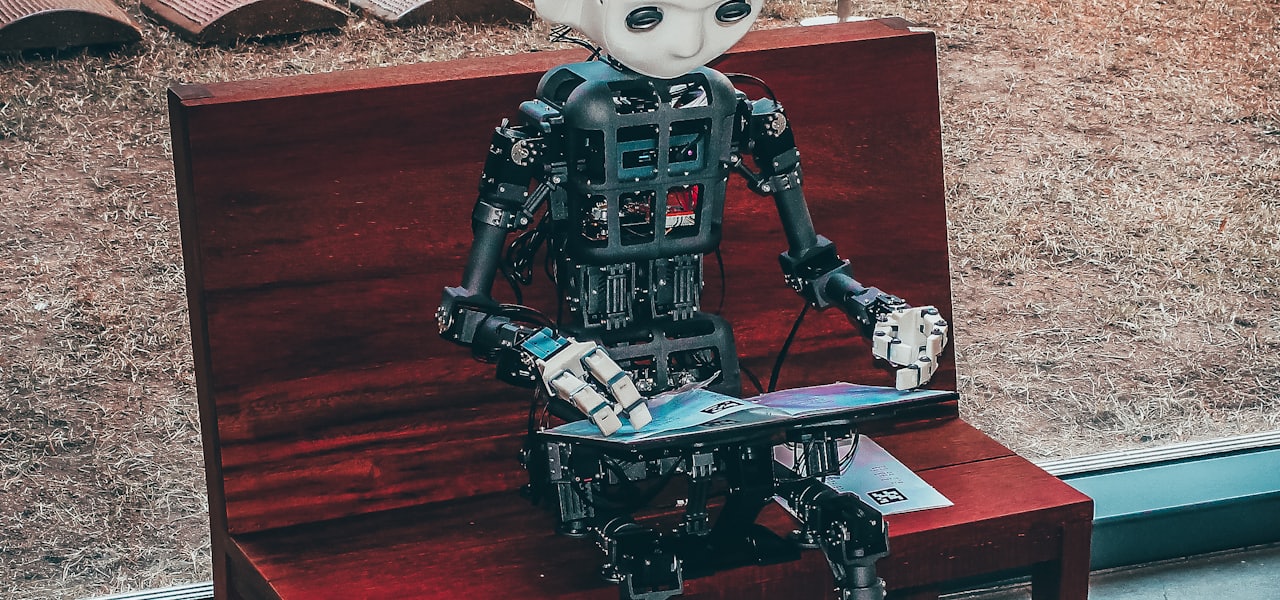
Language technology, often called human language technology (HLT), studies methods of how computer programs or electronic devices can analyze, produce, modify or respond to human texts and speech. Working with language technology often requires broad knowledge not only about linguistics but also about computer science. It consists of natural language processing (NLP) and computational linguistics (CL) on the one hand, many application oriented aspects of these, and more low-level aspects such as encoding and speech technology on the other hand. Note that these elementary aspects are normally not considered to be within the scope of related terms such as natural language processing and (applied) computational linguistics, which are otherwise near-synonyms. As an example, for many of the world's lesser known languages, the foundation of language technology is providing communities with fonts and keyboard setups so their languages can be written on computers or mobile devices. Other tools also are part of modern language technology and include machine translation, speech recognition, text processing and natural language processing. Large scale AI models have recently advanced the field and enhanced the ability of machines to interpret complex human context.
Systems development life cycle
The systems development life cycle (SDLC) describes the typical phases and progression between phases during the development of a computer-based system. These phases progress from inception to retirement. At base, there is just one life cycle, but the taxonomy used to describe it may vary; the cycle may be classified into different numbers of phases and various names may be used for those phases. The SDLC is analogous to the life cycle of a living organism from its birth to its death. In particular, the SDLC varies by system in much the same way that each living organism has a unique path through its life. The SDLC does not prescribe how engineers should go about their work to move the system through its life cycle. Prescriptive techniques are referred to using various terms such as methodology, model, framework, and formal process. Other terms are used for the same concept as SDLC, including software development life cycle (also SDLC), application development life cycle (ADLC), and system design life cycle (also SDLC). These other terms focus on a different scope of development and are associated with different prescriptive techniques, but are about the same essential life cycle. The term "life cycle" is often written without a space, as "lifecycle", with the former more popular in the past and in non-engineering contexts. The acronym SDLC was coined when the longer form was more popular and has remained associated with the expansion, even though the shorter form is popular in engineering. Also, SDLC is relatively unique as opposed to the TLA SDL, which is highly overloaded. == Phases == Depending on the source, the SDLC is described as having different phases and using different terms. Even so, there are common aspects. The following attempts to describe notable phases using notable terminology. The phases are somewhat ordered by the natural sequence of development, although they can be overlapping and iterative. === Conceptualization === During conceptualization (a.k.a. conceptual design, system investigation, feasibility), options and priorities are considered. A feasibility study can determine whether the development effort is worthwhile via activities such as understanding user needs, cost estimation, benefit analysis, and resource analysis. A study should address operational, financial, technical, human factors, and legal/political concerns. === Requirements analysis === Requirements analysis (a.k.a. preliminary design) involves understanding the problem and determining what is needed. Often this involves engaging users to define the requirements and recording them in a document known as a requirements specification. === Design === During the design phase (a.k.a. detail design), a solution is planned. The plan can include relatively high-level information such as describing the major components of the system. The plan can include relatively low-level information such as describing functions, screen layout, business rules, and process flow. The design phase is informed by the requirements of the system. The design must satisfy each requirement. The design may be recorded in textual documents as well as functional hierarchy diagrams, example screen images, business rules, process diagrams, pseudo-code, and data models. === Construction === During construction (a.k.a. implementation, production), the system is realized. Based on the design, hardware and software components are created and integrated. This phase includes testing sub-components, components and the integration of some components, but typically does not include testing at the complete system level. This phase may include the development of training materials, including user manuals and help files. === Acceptance === The acceptance phase (a.k.a. system testing) is about testing the complete system to ensure that it meets customer expectations (requirements). === Deployment === The deployment phase (a.k.a. implementation) involves the logistics of delivery to the customer. Some systems are deployed as a single instance (i.e. in the cloud), and deployment may be ad hoc and manual. Some systems are built in quantity and are associated with manufacturing process and commissioning. This phase may include training users to use the system. It may include transitioning future development to support staff. === Maintenance === During the maintenance phase (a.k.a. operation, utilization, support) development is largely inactive, although this phase does include customer support for resolving user issues and recording suggestions for improvement. Fixes and enhancements are handled by returning to the first phase, conceptualization. For minor changes, the cycle may be significantly abbreviated compared to initial development. === Decommission === Decommission (a.k.a. disposition, retirement, phase-out) is when the system is removed from use, i.e., when it reaches end-of-life. == Practices == === Management and control === SDLC phase objectives are described in this section with key deliverables, a description of recommended tasks, and a summary of related control objectives for effective management. It is critical for the project manager to establish and monitor control objectives while executing projects. Control objectives are clear statements of the desired result or purpose and should be defined and monitored throughout a project. Control objectives can be grouped into major categories (domains), and relate to the SDLC phases as shown in the figure. To manage and control a substantial SDLC initiative, a work breakdown structure (WBS) captures and schedules the work. The WBS and all programmatic material should be kept in the "project description" section of the project notebook. The project manager chooses a WBS format that best describes the project. The diagram shows that coverage spans numerous phases of the SDLC, but the associated MCD (Management Control Domains) shows mappings to SDLC phases. For example, Analysis and Design is primarily performed as part of the Acquisition and Implementation Domain, and System Build and Prototype is primarily performed as part of delivery and support. === Work breakdown structured organization === The upper section of the WBS provides an overview of the project scope and timeline. It should also summarize the major phases and milestones. The middle section is based on the SDLC phases. WBS elements consist of milestones and tasks to be completed rather than activities to be undertaken, and have a deadline. Each task has a measurable output (e.g., an analysis document). A WBS task may rely on one or more activities (e.g., coding). Parts of the project needing support from contractors should have a statement of work (SOW). The development of an SOW does not occur during a specific phase of SDLC but is developed to include the work from the SDLC process that may be conducted by contractors. === Baselines === Baselines are established after four of the five phases of the SDLC, and are critical to the iterative nature of the model. Baselines become milestones. functional baseline: established after the conceptual design phase. allocated baseline: established after the preliminary design phase. product baseline: established after the detailed design and development phase. updated product baseline: established after the production construction phase. In the following diagram, these stages are divided into ten steps, from definition to creation and modification of IT work products:
Rumelhart Prize
The David E. Rumelhart Prize for Contributions to the Theoretical Foundations of Human Cognition was founded in 2001 in honor of the cognitive scientist David Rumelhart to introduce the equivalent of a Nobel Prize for cognitive science. It is awarded annually to "an individual or collaborative team making a significant contemporary contribution to the theoretical foundations of human cognition". The annual award is presented at the Cognitive Science Society meeting, where the recipient gives a lecture and receives a check for $100,000. At the conclusion of the ceremony, the next year's award winner is announced. The award is funded by the Robert J. Glushko and Pamela Samuelson Foundation. The Rumelhart Prize committee is independent of the Cognitive Science Society. However, the society provides a large and interested audience for the awards. == Selection Committee == As of 2022, the selection committee for the prize consisted of: Richard Cooper (chair) Dedre Gentner Robert J. Glushko Tania Lombrozo Steven T. Piantadosi Jesse Snedeker == Recipients ==
Vehicle infrastructure integration
The Vehicle Infrastructure Integration (VII), also known as "Connected Roadways" or "vehicle-to-everything" (V2X) technology, is a United States Department of Transportation initiative that aims to improve road safety by developing technology that connects road vehicles with their environment. This development draws on several disciplines, including transport engineering, electrical engineering, automotive engineering, telematics, and computer science. Although VII specifically covers road transport, similar technologies are under development for other modes of transport. For example, airplanes may use ground-based beacons for automated guidance, allowing the autopilot to fly the plane without human intervention. == Goals == The goal of VII is to establish a communication link between vehicles (via On-Board Equipment, or OBE) and roadside infrastructure (via Roadside Equipment, or RSE) to enhance the safety, efficiency, and convenience of transportation systems. Two potential approaches are the widespread deployment of a dedicated short-range communications (DSRC) link on the 5.9GHz band, and cellular communication (C-V2X). Either of these methods would allow vehicle-to-vehicle (V2V) and vehicle-to-infrastructure (V2I) communication. The initiative has three priorities: Stakeholder evaluation and acceptance of the business model and its deployment schedule, Validation of the technology, with a focus on communications systems, in relation to deployment costs, and Creation of legal structures and policies, especially concerning digital privacy, to improve the system's long-term potential for success. === Safety === Current automotive safety technology relies primarily on vehicle-based radar, lidar, and sonar systems. This technology allows, for instance, a potential reduction in rear-end collisions by monitoring obstacles in front of or behind the vehicle and automatically applying the brakes when necessary. This technology, however, is limited by the sensing range of vehicle-based radar, particularly in angled and left-turn collisions, such as a motorist losing control of the vehicle during an impending head-on collision. The rear-end collisions addressed by current technology are generally less severe than angled, left-turn, or head-on collisions. VII promotes the development of a direct communication link between road vehicles and all other vehicles nearby, allowing for the exchange of information on vehicle speed and orientation or driver awareness and intent. This real-time exchange of information may enable more effective automated emergency maneuvers, such as steering, decelerating, or braking. In addition to nearby vehicle awareness, VII promotes a communication link between vehicles and roadway infrastructure. Such a link may allow for improved real-time traffic information, better queue management, and feedback to vehicles. Existing implementations of VII use vehicle-based sensors that can recognize and respond to roadway markings or signs, automatically adjusting vehicle parameters to follow the recognized instructions. However, this information may also be acquired via roadside beacons or stored in a centralized database accessible to all vehicles. === Efficiency === With a VII system in place, vehicles will be linked together. The headway between vehicles may therefore be reduced so that there is less empty space on the road, increasing the available capacity per lane. More capacity per lane will in turn imply fewer lanes in general, possibly satisfying the community's concerns about the impact of roadway widening. VII will enable precise traffic-signal coordination by tracking vehicle platoons and will benefit from accurate timing by drawing on real-time traffic data covering volume, density, and turning movements. Real-time traffic data can also be used in the design of new roadways or modification of existing systems as the data could be used to provide accurate origin-destination studies and turning-movement counts for uses in transportation forecasting and traffic operations. Such technology would also lead to improvements for transport engineers to address problems whilst reducing the cost of obtaining and compiling data. Tolling is another prospect for VII technology as it could enable roadways to be automatically tolled. Data could be collectively transmitted to road users for in-vehicle display, outlining the lowest cost, shortest distance, and/or fastest route to a destination on the basis of real-time conditions. === Existing applications === To some extent, results along these lines have been achieved in trials performed around the globe, making use of GPS, mobile phone signals, and vehicle registration plates. GPS is becoming standard in many new high-end vehicles and is an option on most new low- and mid-range vehicles. In addition, many users also have mobile phones that transmit trackable signals (and may also be GPS-enabled). Mobile phones can already be traced for purposes of emergency response. GPS and mobile phone tracking, however, do not provide fully reliable data. Furthermore, integrating mobile phones in vehicles may be prohibitively difficult. Data from mobile phones, though useful, might even increase risks to motorists as they tend to look at their phones rather than concentrate on their driving. Automatic registration plate recognition can provide large quantities of data, but continuously tracking a vehicle through a corridor is a difficult task with existing technology. Today's equipment is designed for data acquisition and functions such as enforcement and tolling, not for returning data to vehicles or motorists for response. GPS will nevertheless be one of the key components in VII systems. == Limitations == === Privacy === VII architecture is designed to prevent identification of individual vehicles, with all data exchange between the vehicle and the system occurring anonymously. Exchanges between the vehicles and third parties such as OEMs and toll collectors will occur, but the network traffic will be sent via encrypted tunnels and will therefore not be decipherable by the VII system. Data sharing with law enforcement or Homeland Security was not included in system design as of 2006. === Technical issues === ==== Coordination ==== A major issue facing the deployment of VII is the problem of how to set up the system initially. The costs associated with installing the technology in vehicles and providing communications and power at every intersection are significant. ==== Maintenance ==== Another factor for consideration in regard to the technology's distribution is how to update and maintain the units. Traffic systems are highly dynamic, with new traffic controls implemented every day and roadways constructed or repaired every year. The vehicle-based option could be updated via the internet (preferably wireless) but may subsequently require all users to have access to internet technology. Alternatively, if receivers were placed in all vehicles and the VII system was primarily located along the roadside, information could be stored in a centralized database. This would allow the agency responsible to issue updates at any time. These would then be disseminated to the roadside units for passing motorists. Operationally, this method is currently considered to provide the greatest effectiveness but at a high cost to the authorities. ==== Security ==== Security of the units is another concern, especially in light of the public acceptance issue. Criminals could tamper, remove, or destroy VII units regardless of whether they are installed inside vehicles or along the roadside. Magnets, electric shocks, and malicious software (viruses, hacking, or jamming) could be used to damage VII systems – regardless of whether units are located inside vehicle or along the roadside. == Recent developments == Much of the current research and experimentation is conducted in the United States where coordination is ensured through the Vehicle Infrastructure Integration Consortium; consisting of automobile manufacturers (Ford, General Motors, Daimler Chrysler, Toyota, Nissan, Honda, Volkswagen, BMW), IT suppliers, U.S. Federal and state transportation departments, and professional associations. Trialing is taking place in Michigan and California. The specific applications now being developed under the U.S. initiative are: Warning drivers of unsafe conditions or imminent collisions. Warning drivers if they are about to run off the road or speed around a curve too fast. Informing system operators of real-time congestion, weather conditions and incidents. Providing operators with information on corridor capacity for real-time management, planning and provision of corridor-wide advisories to drivers. In mid-2007, a VII environment covering some 20 square miles (52 km2) near Detroit was used to test 20 prototype VII applications. Several automobile manufacturers are also conducting their own VII research and triali
AI Seoul Summit 2024
The AI Seoul Summit 2024 was an event in May 2024 co-hosted by the South Korean and British governments. The Seoul Declaration was adopted to address artificial intelligence technology and related challenges and opportunities. == Background == The AI Seoul Summit is the second such meeting following the AI Safety Summit held in the United Kingdom in November 2023. In the Bletchley Declaration, the participating countries agreed to prioritize identifying AI safety risks of shared concern, a shared concern, but at the Seoul Summit, the leaders also recognized the importance of AI. == Notable attendees == The summit was attended by the leaders of Group of Seven countries, including the United States, Canada, France, and Germany, South Korea, Singapore and Australia, representatives of the United Nations, the Organisation for Economic Co-operation and Development, and the European Union. Also in attendance were representatives of global companies such as Tesla CEO Elon Musk, Samsung Electronics Chairman Lee Jae-yong, ChatGPT maker OpenAI, Google, Microsoft, Meta, and South Korea's top portal operator Naver. == Topics == === South Korean AI safety center === "South Korea will push forward with the establishment of an AI safety research center in Korea and join a network to boost the global safety of AI." Minister of Science, Lee Jong-ho said that South Korea was planning to open an AI Safety Institute in 2024. He also expressed his intention to strengthen cooperation for the development of international standards. === Seoul Declaration for Safe, Innovative and Inclusive AI === The Seoul Declaration was adopted at the summit by leaders representing the EU, the US, the UK, Australia, Canada, Germany, France, Italy, Japan, South Korea, and Singapore. The declaration is a commitment to foster international cooperation to help develop AI governance frameworks that are interoperable between countries, partly by integrating the Hiroshima Process International Code of Conduct for Organizations Developing Advanced AI Systems. It advocates for the development of human-centric AI in collaboration with the private sector, academia, and civil society. === Seoul Ministerial Statement for advancing AI safety === At the ministerial meeting of the summit, the Seoul Ministerial Statement, a joint statement calling for the improvement of the safety, innovation, and inclusivity of AI technologies, was adopted by ministers from Australia, Canada, Chile, France, Germany, India, Indonesia, Israel, Italy, Japan, Kenya, Mexico, the Netherlands, Nigeria, New Zealand, the Philippines, South Korea, Rwanda, Saudi Arabia, Singapore, Spain, Switzerland, Turkey, Ukraine, the United Arab Emirates, the UK, and the US, as well as an EU representative. It aims to develop low-power chips as the AI industry rapidly expands and massive consumption is expected. == Global AI Summit series ==
Harris corner detector
The Harris corner detector is a corner detection operator that is commonly used in computer vision algorithms to extract corners and infer features of an image. It was first introduced by Chris Harris and Mike Stephens in 1988 upon the improvement of Moravec's corner detector. Compared to its predecessor, Harris' corner detector takes the differential of the corner score into account with reference to direction directly, instead of using shifting patches for every 45 degree angles, and has been proved to be more accurate in distinguishing between edges and corners. Since then, it has been improved and adopted in many algorithms to preprocess images for subsequent applications. == Introduction == A corner is a point whose local neighborhood stands in two dominant and different edge directions. In other words, a corner can be interpreted as the junction of two edges, where an edge is a sudden change in image brightness. Corners are the important features in the image, and they are generally termed as interest points which are invariant to translation, rotation and illumination. Although corners are only a small percentage of the image, they contain the most important features in restoring image information, and they can be used to minimize the amount of processed data for motion tracking, image stitching, building 2D mosaics, stereo vision, image representation and other related computer vision areas. In order to capture the corners from the image, researchers have proposed many different corner detectors including the Kanade-Lucas-Tomasi (KLT) operator and the Harris operator which are most simple, efficient and reliable for use in corner detection. These two popular methodologies are both closely associated with and based on the local structure matrix. Compared to the Kanade-Lucas-Tomasi corner detector, the Harris corner detector provides good repeatability under changing illumination and rotation, and therefore, it is more often used in stereo matching and image database retrieval. Although there still exist drawbacks and limitations, the Harris corner detector is still an important and fundamental technique for many computer vision applications. == Development of Harris corner detection algorithm == Source: Without loss of generality, we will assume a grayscale 2-dimensional image is used. Let this image be given by I {\displaystyle I} . Consider taking an image patch ( x , y ) ∈ W {\displaystyle (x,y)\in W} (window) and shifting it by ( Δ x , Δ y ) {\displaystyle (\Delta x,\Delta y)} . The sum of squared differences (SSD) between these two patches, denoted f {\displaystyle f} , is given by: f ( Δ x , Δ y ) = ∑ ( x k , y k ) ∈ W ( I ( x k , y k ) − I ( x k + Δ x , y k + Δ y ) ) 2 {\displaystyle f(\Delta x,\Delta y)={\underset {(x_{k},y_{k})\in W}{\sum }}\left(I(x_{k},y_{k})-I(x_{k}+\Delta x,y_{k}+\Delta y)\right)^{2}} I ( x + Δ x , y + Δ y ) {\displaystyle I(x+\Delta x,y+\Delta y)} can be approximated by a Taylor expansion. Let I x {\displaystyle I_{x}} and I y {\displaystyle I_{y}} be the partial derivatives of I {\displaystyle I} , such that I ( x + Δ x , y + Δ y ) ≈ I ( x , y ) + I x ( x , y ) Δ x + I y ( x , y ) Δ y {\displaystyle I(x+\Delta x,y+\Delta y)\approx I(x,y)+I_{x}(x,y)\Delta x+I_{y}(x,y)\Delta y} This produces the approximation f ( Δ x , Δ y ) ≈ ∑ ( x , y ) ∈ W ( I x ( x , y ) Δ x + I y ( x , y ) Δ y ) 2 , {\displaystyle f(\Delta x,\Delta y)\approx {\underset {(x,y)\in W}{\sum }}\left(I_{x}(x,y)\Delta x+I_{y}(x,y)\Delta y\right)^{2},} which can be written in matrix form: f ( Δ x , Δ y ) ≈ ( Δ x Δ y ) M ( Δ x Δ y ) , {\displaystyle f(\Delta x,\Delta y)\approx {\begin{pmatrix}\Delta x&\Delta y\end{pmatrix}}M{\begin{pmatrix}\Delta x\\\Delta y\end{pmatrix}},} where M is the structure tensor, M = ∑ ( x , y ) ∈ W [ I x 2 I x I y I x I y I y 2 ] = [ ∑ ( x , y ) ∈ W I x 2 ∑ ( x , y ) ∈ W I x I y ∑ ( x , y ) ∈ W I x I y ∑ ( x , y ) ∈ W I y 2 ] {\displaystyle M={\underset {(x,y)\in W}{\sum }}{\begin{bmatrix}I_{x}^{2}&I_{x}I_{y}\\I_{x}I_{y}&I_{y}^{2}\end{bmatrix}}={\begin{bmatrix}{\underset {(x,y)\in W}{\sum }}I_{x}^{2}&{\underset {(x,y)\in W}{\sum }}I_{x}I_{y}\\{\underset {(x,y)\in W}{\sum }}I_{x}I_{y}&{\underset {(x,y)\in W}{\sum }}I_{y}^{2}\end{bmatrix}}} == Process of Harris corner detection algorithm == Commonly, Harris corner detector algorithm can be divided into five steps. Color to grayscale Spatial derivative calculation Structure tensor setup Harris response calculation Non-maximum suppression === Color to grayscale === If we use Harris corner detector in a color image, the first step is to convert it into a grayscale image, which will enhance the processing speed. The value of the gray scale pixel can be computed as a weighted sums of the values R, B and G of the color image, ∑ C ∈ { R , G , B } w C ⋅ C {\displaystyle \sum _{C\,\in \,\{R,G,B\}}w_{C}\cdot C} , where, e.g., w R = 0.299 , w G = 0.587 , w B = 1 − ( w R + w G ) = 0.114. {\displaystyle w_{R}=0.299,\ w_{G}=0.587,\ w_{B}=1-(w_{R}+w_{G})=0.114.} === Spatial derivative calculation === Next, we are going to find the derivative with respect to x and the derivative with respect to y, I x ( x , y ) {\displaystyle I_{x}(x,y)} and I y ( x , y ) {\displaystyle I_{y}(x,y)} . This can be approximated by applying Sobel operators. === Structure tensor setup === With I x ( x , y ) {\displaystyle I_{x}(x,y)} , I y ( x , y ) {\displaystyle I_{y}(x,y)} , we can construct the structure tensor M {\displaystyle M} . === Harris response calculation === For x ≪ y {\displaystyle x\ll y} , one has x ⋅ y x + y = x 1 1 + x / y ≈ x . {\displaystyle {\tfrac {x\cdot y}{x+y}}=x{\tfrac {1}{1+x/y}}\approx x.} In this step, we compute the smallest eigenvalue of the structure tensor using that approximation: λ min ≈ λ 1 λ 2 ( λ 1 + λ 2 ) = det ( M ) tr ( M ) {\displaystyle \lambda _{\min }\approx {\frac {\lambda _{1}\lambda _{2}}{(\lambda _{1}+\lambda _{2})}}={\frac {\det(M)}{\operatorname {tr} (M)}}} with the trace t r ( M ) = m 11 + m 22 {\displaystyle \mathrm {tr} (M)=m_{11}+m_{22}} . Another commonly used Harris response calculation is shown as below, R = λ 1 λ 2 − k ( λ 1 + λ 2 ) 2 = det ( M ) − k tr ( M ) 2 {\displaystyle R=\lambda _{1}\lambda _{2}-k(\lambda _{1}+\lambda _{2})^{2}=\det(M)-k\operatorname {tr} (M)^{2}} where k {\displaystyle k} is an empirically determined constant; k ∈ [ 0.04 , 0.06 ] {\displaystyle k\in [0.04,0.06]} . === Non-maximum suppression === In order to pick up the optimal values to indicate corners, we find the local maxima as corners within the window which is a 3 by 3 filter. == Improvement == Sources: Harris-Laplace Corner Detector Differential Morphological Decomposition Based Corner Detector Multi-scale Bilateral Structure Tensor Based Corner Detector == Applications == Image Alignment, Stitching and Registration 2D Mosaics Creation 3D Scene Modeling and Reconstruction Motion Detection Object Recognition Image Indexing and Content-based Retrieval Video Tracking
Stable Diffusion
Stable Diffusion is a deep learning, text-to-image model released in 2022 based on diffusion techniques. The generative artificial intelligence technology is the premier product of Stability AI and is considered to be a part of the ongoing AI boom. It is primarily used to generate detailed images conditioned on text descriptions, though it can also be applied to other tasks such as inpainting, outpainting, and generating image-to-image translations guided by a text prompt. Its development involved researchers from the CompVis Group at LMU Munich and Runway with a computational donation from Stability and training data from non-profit organizations. Stable Diffusion is a latent diffusion model, a kind of deep generative artificial neural network. Its code and model weights have been released publicly, and an optimized version can run on most consumer hardware equipped with a modest GPU with as little as 2.4 GB VRAM. This marked a departure from previous proprietary text-to-image models such as DALL-E and Midjourney which were accessible only via cloud services. == Development == Stable Diffusion originated from a project called Latent Diffusion, developed in Germany by researchers at LMU Munich in Munich and Heidelberg University. Four of the original 5 authors (Robin Rombach, Andreas Blattmann, Patrick Esser and Dominik Lorenz) later joined Stability AI and released subsequent versions of Stable Diffusion. The technical license for the model was released by the CompVis group at LMU Munich. Development was led by Patrick Esser of Runway and Robin Rombach of CompVis, who were among the researchers who had earlier invented the latent diffusion model architecture used by Stable Diffusion. Stability AI also credited EleutherAI and LAION (a German nonprofit which assembled the dataset on which Stable Diffusion was trained) as supporters of the project. == Technology == === Architecture === Diffusion models, introduced in 2015, are trained with the objective of removing successive applications of Gaussian noise on training images, which can be thought of as a sequence of denoising autoencoders. The name diffusion is from the thermodynamic diffusion, since they were first developed with inspiration from thermodynamics. Models in Stable Diffusion series before SD 3 all used a variant of diffusion models, called latent diffusion model (LDM), developed in 2021 by the CompVis (Computer Vision & Learning) group at LMU Munich. Stable Diffusion consists of 3 parts: the variational autoencoder (VAE), U-Net, and an optional text encoder. The VAE encoder compresses the image from pixel space to a smaller dimensional latent space, capturing a more fundamental semantic meaning of the image. Gaussian noise is iteratively applied to the compressed latent representation during forward diffusion. The U-Net block, composed of a ResNet backbone, denoises the output from forward diffusion backwards to obtain a latent representation. Finally, the VAE decoder generates the final image by converting the representation back into pixel space. The denoising step can be flexibly conditioned on a string of text, an image, or another modality. The encoded conditioning data is exposed to denoising U-Nets via a cross-attention mechanism. For conditioning on text, the fixed, pretrained CLIP ViT-L/14 text encoder is used to transform text prompts to an embedding space. Researchers point to increased computational efficiency for training and generation as an advantage of LDMs. With 860 million parameters in the U-Net and 123 million in the text encoder, Stable Diffusion is considered relatively lightweight by 2022 standards, and unlike other diffusion models, it can run on consumer GPUs, and even CPU-only if using the OpenVINO version of Stable Diffusion. ==== SD XL ==== The XL version uses the same LDM architecture as previous versions, except larger: larger UNet backbone, larger cross-attention context, two text encoders instead of one, and trained on multiple aspect ratios (not just the square aspect ratio like previous versions). The SD XL Refiner, released at the same time, has the same architecture as SD XL, but it was trained for adding fine details to preexisting images via text-conditional img2img. ==== SD 3.0 ==== The 3.0 version completely changes the backbone. Not a UNet, but a Rectified Flow Transformer, which implements the rectified flow method with a Transformer. The Transformer architecture used for SD 3.0 has three "tracks", for original text encoding, transformed text encoding, and image encoding (in latent space). The transformed text encoding and image encoding are mixed during each transformer block. The architecture is named "multimodal diffusion transformer (MMDiT), where the "multimodal" means that it mixes text and image encodings inside its operations. This differs from previous versions of DiT, where the text encoding affects the image encoding, but not vice versa. === Training data === Stable Diffusion was trained on pairs of images and captions taken from LAION-5B, a publicly available dataset derived from Common Crawl data scraped from the web, where 5 billion image-text pairs were classified based on language and filtered into separate datasets by resolution, a predicted likelihood of containing a watermark, and predicted "aesthetic" score (e.g. subjective visual quality). The dataset was created by LAION, a German non-profit which receives funding from Stability AI. The Stable Diffusion model was trained on three subsets of LAION-5B: laion2B-en, laion-high-resolution, and laion-aesthetics v2 5+. A third-party analysis of the model's training data identified that out of a smaller subset of 12 million images taken from the original wider dataset used, approximately 47% of the sample size of images came from 100 different domains, with Pinterest taking up 8.5% of the subset, followed by websites such as WordPress, Blogspot, Flickr, DeviantArt and Wikimedia Commons. An investigation by Bayerischer Rundfunk showed that LAION's datasets, hosted on Hugging Face, contain large amounts of private and sensitive data. === Training procedures === The model was initially trained on the laion2B-en and laion-high-resolution subsets, with the last few rounds of training done on LAION-Aesthetics v2 5+, a subset of 600 million captioned images which the LAION-Aesthetics Predictor V2 predicted that humans would, on average, give a score of at least 5 out of 10 when asked to rate how much they liked them. The LAION-Aesthetics v2 5+ subset also excluded low-resolution images and images which LAION-5B-WatermarkDetection identified as carrying a watermark with greater than 80% probability. Final rounds of training additionally dropped 10% of text conditioning to improve Classifier-Free Diffusion Guidance. The model was trained using 256 Nvidia A100 GPUs on Amazon Web Services for a total of 150,000 GPU-hours, at a cost of $600,000. === Limitations === Stable Diffusion has issues with degradation and inaccuracies in certain scenarios. Initial releases of the model were trained on a dataset that consists of 512×512 resolution images, meaning that the quality of generated images noticeably degrades when user specifications deviate from its "expected" 512×512 resolution; the version 2.0 update of the Stable Diffusion model later introduced the ability to natively generate images at 768×768 resolution. Another challenge is in generating human limbs due to poor data quality of limbs in the LAION database. The model is insufficiently trained to replicate human limbs and faces due to the lack of representative features in the database, and prompting the model to generate images of such type can confound the model. In addition to human limbs, Stable Diffusion is unable to generate legible ambigrams and some other forms of text and typography. Stable Diffusion XL (SDXL) version 1.0, released in July 2023, introduced native 1024x1024 resolution and improved generation for limbs and text. Accessibility for individual developers can also be a problem. In order to customize the model for new use cases that are not included in the dataset, such as generating anime characters ("waifu diffusion"), new data and further training are required. Fine-tuned adaptations of Stable Diffusion created through additional retraining have been used for a variety of different use-cases, from medical imaging to algorithmically generated music. However, this fine-tuning process is sensitive to the quality of new data; low resolution images or different resolutions from the original data can not only fail to learn the new task but degrade the overall performance of the model. Even when the model is additionally trained on high quality images, it is difficult for individuals to run models in consumer electronics. For example, the training process for waifu-diffusion requires a minimum 30 GB of VRAM, which exceeds the usual resource provided in such consumer GPUs as Nvidia's GeForce 30 series, w